What would change if you stopped assuming that every meaningful future had to be produced through pressure? What if the next stage of your life does not need you to push harder, but to become stable enough to hold what is already trying to emerge?
Many of us have learned to recognize progress through visible movement. We set goals, make plans, complete tasks, and look for evidence that we are advancing toward something worthwhile. When nothing obvious seems to be happening, we may become anxious. We interpret stillness as stagnation, uncertainty as failure, and rest as time we should be using more productively.
But not every meaningful process develops through acceleration.
Some things require incubation.
An idea may need additional experiences before its shape becomes clear. A relationship may need time before trust can support deeper commitments. A person may need to recover from previous demands before they can recognize what they genuinely want next. During these periods, very little may be visible from the outside, but that does not mean nothing is happening.
Within the Grove Temple’s Civic Metaphysics, this distinction matters because relationships generate possibilities that cannot always be scheduled in advance. We can create conditions that support emergence, but we cannot guarantee when something meaningful will become ready.
The question becomes not simply, How do I make this happen?
It becomes: What conditions would allow this to become livable?
When Incubation Replaces Pressure
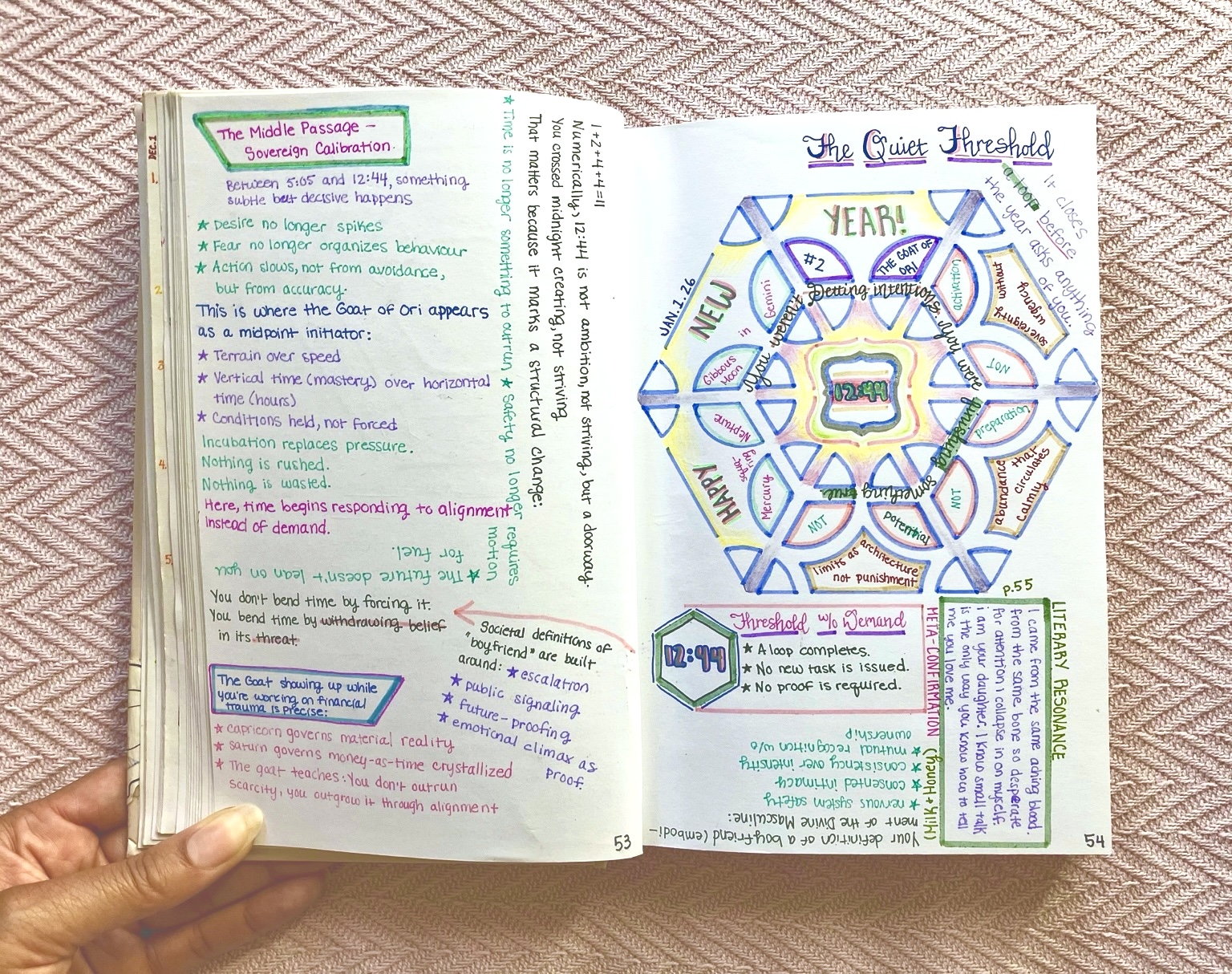
In the Record of Resonance, the entry for the 12:44 timestamp describes a transition called The Quiet Threshold. The notes read:
“Conditions held, not forced.”
“Incubation replaces pressure.”
“Nothing is rushed. Nothing is wasted.”
And then:
“Here, time begins responding to alignment instead of demand.”
This is a very different relationship with the future.
Pressure assumes that something becomes real because we continually push it toward completion. Incubation recognizes that some structures cannot be forced into maturity. They have to become capable of supporting themselves.
That does not mean doing nothing. Incubation can involve observing, experimenting, learning, preparing, resting, changing direction, and allowing information to accumulate. What changes is the assumption that every action must immediately produce measurable progress.
Sometimes the most important thing we can do is create enough stability for the next structure to become possible.
Temporal Sovereignty
The Grove Temple uses the term temporal sovereignty for the ability to participate meaningfully in decisions about how our time is committed, protected, and allowed to develop. That is more complicated than simply “having good boundaries.”
Our time is shaped by work, money, health, caregiving, institutions, and other people’s expectations. A person may technically be allowed to say no while knowing that refusing a demand will threaten their employment, relationships, or belonging. So temporal sovereignty is not only an individual practice. It is also a relational and institutional question.
Do the communities we participate in allow people to step back without punishing them? Can responsibilities be redistributed when someone’s capacity changes? Does every opportunity immediately become an obligation? Are people allowed periods in which their contribution is not visible or measurable?
A community that values sovereignty has to make room for those realities. Otherwise, “be generative” can quietly become another version of “always be useful.”
Rest Is Not a Productivity Strategy
Even our definittions of rest often remain trapped inside productivity culture.
We are told to rest because rest improves focus. Take a break so you can work harder tomorrow. Sleep more so you can perform better. Protect yourself from burnout so you can continue producing. Those benefits may be real, but they still make productivity the authority that determines whether rest is legitimate.
The Grove Temple approaches this differently.
Rest does not need to prove that it will eventually produce something valuable. People do not become worthy of care only when their recovery restores their previous usefulness. Some periods of rest lead to renewed productivity. Others change what a person is capable of or interested in doing altogether. A generative relationship should be capable of accommodating those changes.
An extractive relationship asks, When will you be useful again?
A generative relationship asks, What conditions allow you to continue existing and developing as a whole person?
That difference is enormous.
The Future Is Not a Debt
There is another way pressure enters our lives: through the futures we imagine.
Goals can orient us toward possibilities that matter. But sometimes an imagined future begins functioning like a debt we already owe.
We tell ourselves that the project must succeed because we have already invested so much in it. The institution must grow because people are depending on us. The opportunity cannot be refused because it might never return. We accept increasingly unsustainable conditions because we believe some future achievement will eventually justify them.
In that arrangement, the future acquires an unlimited claim on the present.
But a future worth creating should not require the destruction of the people responsible for reaching it.
The future does not need to lean on you for fuel.
That does not mean abandoning ambition. It means asking whether the way we pursue our ambitions preserves the conditions that will allow us to participate in whatever we are building.
Becoming Stable Enough to Hold the Pattern

Another Record of Resonance entry describes a related transition through the timestamp 12:02:
“The structure becomes livable, sensual, and integrated.”
The notes describe this as “structure that nurtures”—the point at which something stops existing only as a theory or aspiration and begins to feel inhabitable.
One line captures the idea especially clearly:
“Structure does not emerge through force. It emerges when the nervous system is stable enough to hold the pattern.”
This is why The Quiet Threshold is not simply a teaching about rest.
It is about the difference between forcing a structure into existence and becoming capable of living inside the structure you are creating.
We can build careers, relationships, organizations, identities, and spiritual practices that look impressive from the outside but remain impossible to inhabit without continual strain. If maintaining a structure requires permanent urgency, collapse, self-distortion, or depletion, then its visible existence does not necessarily mean it has become sustainable.
A livable structure feels different.
There is enough stability for attention to widen. Enough safety for curiosity to return. Enough sovereignty for participation to become voluntary rather than compulsive.
The structure begins to support life instead of consuming it.
A Different Measure of Progress
The Quiet Threshold asks us to reconsider how we recognize progress.
Sometimes progress looks like accomplishment.
Sometimes it looks like increased capacity.
Sometimes it looks like realizing that you no longer need to force the thing you thought you were supposed to want.
And sometimes progress is subtle enough that the only evidence is that you are no longer living in constant reaction to the future.
The question is not always How quickly can I get there?
Sometimes the better question is:
What would need to become true for this future to feel livable once I arrive?
That question shifts our attention away from speed and toward structure.
It asks whether our relationships, commitments, bodies, and communities are developing enough capacity to hold the lives we claim we are trying to create.
The Grove Temple’s Civic Metaphysics is interested in precisely that kind of relationship: not simply what we can force into existence, but what becomes possible when the conditions are finally capable of sustaining it.
Nothing is rushed. Nothing is wasted.
Sometimes the threshold is quiet because, for once, the future is no longer demanding that you chase it.
Continue the Civic Metaphysics Series
The Quiet Threshold is the third sermon in the Grove Temple’s Civic Metaphysics series, an ongoing exploration of how relationships shape reality, how we participate in social fields, and what makes those relationships generative or extractive.
If you want to read the full series in order—including the longer Patreon versions of these teachings—you can explore the complete Civic Metaphysics collection on Patreon.