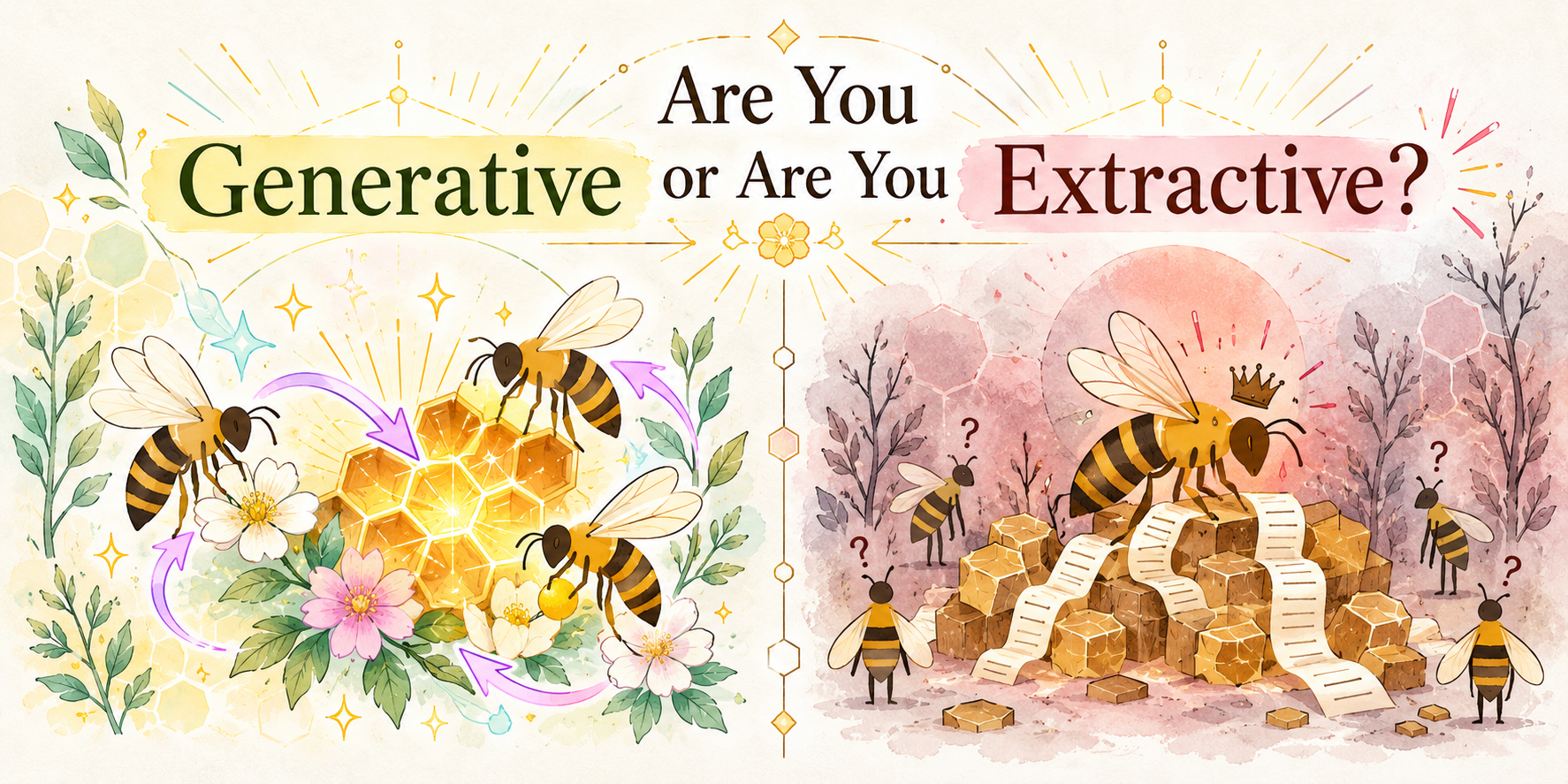
How understanding your relationships can help you build a healthier, more supportive community
Have you ever wondered why some relationships leave you feeling more capable, creative, and connected, while others leave you exhausted, overwhelmed, or dependent? The difference may have less to do with whether the people involved have good intentions and more to do with what their relationships actually produce.
At the Grove Temple of Elysian Mysteries, we explore this distinction through Civic Metaphysics, our developing philosophy of how relationships shape the social world. One of its central principles is that relationships do more than connect individuals. They create conditions that influence what people can think, accomplish, experience, and become.
Every interaction changes the possibilities available within a community. Some relationships expand those possibilities, while others consume the very resources and capacities that make them possible. Understanding the difference between generativity and extraction can help us recognize unhealthy patterns, establish better boundaries, and build relationships that sustain everyone involved.
What Makes a Relationship Generative?

A generative relationship increases the capacity of the people and communities participating in it. It creates opportunities for learning, creativity, cooperation, trust, and mutual development that might not have existed otherwise.
Imagine two people approaching a problem from different perspectives. One has technical expertise, while the other understands the community that will be affected by the solution. Neither possesses everything necessary to resolve the problem independently, but through collaboration, they develop something neither could have created alone.
This is generativity in action. Their relationship produces a new possibility without requiring either person to surrender their independence.
Generativity can also appear in ordinary interactions: sharing knowledge that helps someone make an informed decision, offering practical support, connecting people with complementary skills, or establishing structures that allow others to contribute meaningfully.
Importantly, being generative does not mean constantly giving, agreeing with everyone, or making yourself endlessly available. Sometimes the most generative contribution is establishing a boundary, questioning an assumption, or stepping away from an arrangement that has become unsustainable.
Generativity is measured by the possibilities a relationship creates, not simply by how much someone gives.
What Makes a Relationship Extractive?

An extractive relationship consumes the capacities of its participants without adequately contributing to their renewal or development. It may produce visible results, but those results depend on an arrangement that gradually diminishes the people sustaining it.
Consider a community organization in which one person handles nearly every decision, administrative responsibility, and problem. The organization might accomplish impressive things, but its success depends entirely on that person’s continued labor. Meanwhile, other participants have few opportunities to develop their own skills, initiative, or authority.
Although the organization appears productive, its structure is extractive because it concentrates responsibility while limiting the development of collective capacity.
Extraction also occurs in personal relationships. Someone might repeatedly depend on another person’s emotional support without respecting their boundaries or acknowledging their needs. A creative collaborator might benefit from another person’s ideas without recognizing their contributions. A community might demand constant participation while failing to provide the support necessary for its members to remain involved.
These patterns are not always intentional. People can sincerely believe they are participating in supportive relationships while unknowingly reproducing arrangements that leave others depleted.
However, needing care does not make someone extractive. Illness, disability, grief, and financial hardship can create circumstances in which people require substantial assistance. Healthy communities do not measure human worth by productivity or demand equal exchanges in every interaction. Instead, they develop sustainable ways to provide care while respecting the dignity, limitations, and independence of everyone involved.
Why Boundaries Make Relationships Stronger
One of the most important principles of Civic Metaphysics is that sovereignty, the ability to maintain one’s identity, judgment, and boundaries, is a condition of generativity.
A relationship cannot become genuinely collaborative if participation requires people to abandon their independence. When individuals feel unable to disagree, refuse responsibilities, or communicate their limitations, cooperation can become indistinguishable from compliance.
Healthy boundaries make sustainable relationships possible. They allow people to understand what others can realistically contribute, distribute responsibilities appropriately, and develop forms of support that do not depend on indefinite self-sacrifice.
This is particularly important in spiritual communities, where practices such as meditation, divination, and personal reflection can involve sharing deeply meaningful experiences. Genuine intimacy requires more than emotional disclosure. It requires mutual recognition, consent, and respect for the independence of everyone participating.
The goal is not to eliminate differences between people, but to create relationships in which those differences become sources of possibility.
How Our Relationships Become Social Structures
Individual interactions may seem small, but repeated patterns gradually shape entire communities.
When people consistently receive recognition for their contributions, they become more willing to collaborate. When knowledge and responsibility are shared, more people develop the capacity to participate. When disagreement is welcomed rather than punished, communities gain opportunities to learn and adapt.
The opposite is also true. When ideas are appropriated, boundaries are disregarded, or responsibility is concentrated in a few individuals, people may become guarded, disengaged, or dependent on those who hold authority.
Over time, these patterns become the unwritten rules that determine how a community functions.
Civic Metaphysics describes this process as relationship becoming architecture. The structures created through our interactions influence which relationships, opportunities, and forms of participation become possible in the future.
This is why generativity is not simply about being kind or helpful. It concerns whether our relationships are creating conditions in which individuals and communities can continue to grow.
What Does Your Participation Make Possible?
The distinction between generativity and extraction is not intended to divide people into good and bad categories. Most of us participate in both kinds of patterns at different times, often without recognizing their effects.
Instead, the distinction offers a practical way to examine our relationships. When we contribute to a group, are we helping others develop their own capacities or making ourselves indispensable? When we receive support, do we recognize the needs and limitations of those providing it? When we encounter disagreement, can we respect another person’s independence without interpreting it as a threat?
These questions invite us to look beyond intentions and examine the conditions our participation creates.
At the Grove Temple, we believe that building healthier communities begins with understanding how relationships shape the possibilities available to us. By recognizing generative and extractive patterns, we can begin transforming the structures through which we live, work, create, and care for one another.
The question is not simply what we accomplish together, but whether our relationships leave us more capable of creating, connecting, and thriving than we were before.
This article is adapted from “Are You Generative or Are You Extractive?,” part of the Grove Temple’s Civic Metaphysics sermon collection. The full sermon explores the roles of emotional labor, knowledge-sharing, sovereignty, and social architecture in greater depth.